
Animal record lists usually open with a blue whale and close with a cheetah. The better numbers sit further down, in a paper about snail teeth, a study of marsupial digestion, and a force sensor that a shrimp broke.
A beetle that pulls like six double-decker buses
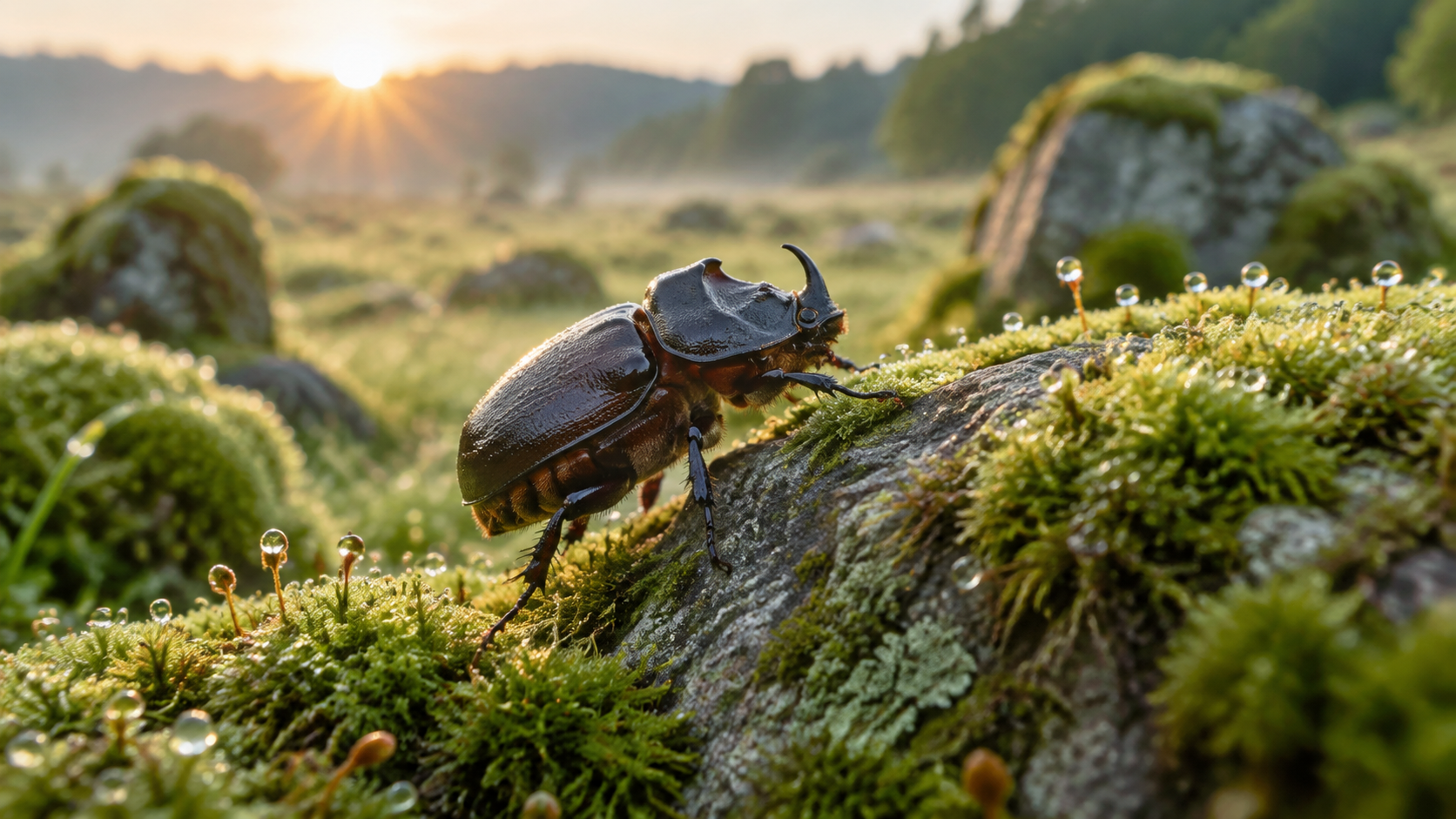
Onthophagus taurus, a horned dung beetle common across Europe and North America, can pull 1,141 times its own body weight. Rob Knell of Queen Mary, University of London and colleagues measured it by tying a thread to the beetle's wing cases and letting the insect brace its legs inside a narrow tunnel, the posture it uses to shove rivals backwards. The work appeared in Proceedings of the Royal Society B. Scaled up, that is a 70 kg person dragging six loaded double-decker buses. The pressure behind it is mundane: males fight in tunnels under dung pats, and the ones that push hardest stay.
The strongest material biology has produced
Limpets rasp algae off rock with a tongue covered in sub-millimetre teeth. In 2015 Asa Barber, then at the University of Portsmouth, and colleagues milled fragments into microscopic dog-bone shapes and pulled them apart inside an atomic force microscope. Tensile strength came out between 3.0 and 6.5 GPa, about 5 GPa on average, past spider silk and close to the best carbon fibre. The reason is fibre diameter: the reinforcing goethite nanofibres are too thin for flaws to form, so the teeth approach their theoretical limit. Journal of the Royal Society Interface published the paper in April 2015.
The only cubic droppings on Earth
Bare-nosed wombats pass faeces shaped like dice, around two centimetres across, up to a hundred a day. Patricia Yang, David Hu and others at Georgia Tech traced the mechanism through dissections and a model: the last 17 percent of the intestine alternates between stiff and soft tissue, roughly twice as thick and four times as stiff in places, and something like 40,000 contractions press flat faces and sharp corners into an already dry pellet. Soft Matter published it in 2021. The explanation for why is unglamorous: cubes stacked on a rock or log stay there while round ones roll off, and wombats use the piles to leave each other messages.
A punch that boils the water around it
The peacock mantis shrimp Odontodactylus scyllarus swings its club at accelerations above 100,000 m/s². Sheila Patek and Roy Caldwell, then at UC Berkeley, recorded peak impact forces of 400 to 1,501 newtons in a 2005 Journal of Experimental Biology study, after the animals destroyed their first force sensor. The data also showed two force peaks per strike, about 400 microseconds apart, and the second is not the limb: it is cavitation bubbles collapsing as the club rebounds, worth up to 504 N alone and at times more than the blow itself.
The loudest sound any animal makes
Sperm whale echolocation clicks reach 236 decibels relative to one micropascal, which Guinness World Records lists as the loudest animal sound. The measurement comes from a 2003 study led by Bertel Møhl of Aarhus University in the Journal of the Acoustical Society of America. Decibels in water are not the same currency as in air, the gap being about 61.5 dB, but Guinness puts 236 dB at roughly 44 times the loudness of a thunderclap to a human ear.
Eleven days without landing
In October 2022 a juvenile bar-tailed godwit tagged 234684 left Alaska and put down in Tasmania 11 days and one hour later, 13,560 km away, without stopping to feed or rest. Guinness World Records lists it as the longest non-stop migration by a bird. Eric Woehler of BirdLife Tasmania reckoned it had lost half or more of its body weight in the air. Arctic terns cover more ground across a full year, but they touch down along the way.
A mammal that fits on a thumb
Kitti's hog-nosed bat, also called the bumblebee bat, measures 29 to 33 mm from head to rump and weighs 1.7 to 2 grams, the smallest mammal by body length in the Guinness listings. It roosts in a handful of limestone caves along the Khwae Noi River in Kanchanaburi Province, Thailand, and in parts of south-east Myanmar. Thai zoologist Kitti Thonglongya collected the first specimens in 1973, and the animal needed a new genus and a new family, Craseonycteridae, all to itself. It forages about 20 minutes at dawn and 30 at dusk, and spends the rest of the day in torpor.
Ten days with the hatch open
In September 2007 dried-out tardigrades flew on ESA's FOTON-M3 mission inside the BIOPAN cassette, 258 to 281 km up, exposed for ten days. The group exposed to vacuum and cosmic radiation alone came back close to unharmed: rehydrate them and they revive, lay eggs, and the eggs hatch. Solar ultraviolet was the killer. Of Milnesium tardigradum exposed to the full solar UV spectrum, three individuals survived. Current Biology published the results in 2008, making the tardigrade the first animal known to have survived open space.
An ant colony with no borders
The largest recorded ant colony stretches roughly 6,000 km, from northern Italy through southern France to the Atlantic coast of Spain. all of them Linepithema humile, the Argentine ant, which reached Europe from South America by accident about a century ago. Ants from opposite ends of the range treat each other as nestmates rather than rivals. A 2009 paper in Insectes Sociaux found the same tolerance between the European, Californian and Japanese supercolonies, and a later PNAS study covering six continents argued they form one intercontinental supercolony from a single ancestral nest. The authors called it the most populous known animal society.
The largest eye ever measured
The colossal squid Mesonychoteuthis hamiltoni carries eyes about 27 cm across with a 12 cm lens, bigger than any other known animal's, extinct ones included. The figure comes from a partly collapsed specimen, and Te Papa, the New Zealand museum holding it, estimates 30 to 40 cm in life. It is also the heaviest invertebrate at 495 kg for confirmed specimens, living in the Southern Ocean where sperm whales hunt it. Researchers think the eyes work less as hunting optics than as a warning system, for seeing something big coming out of the dark.



Ready to start your HMI project?
Our engineers help you choose the right HMI hardware and software for your project.