
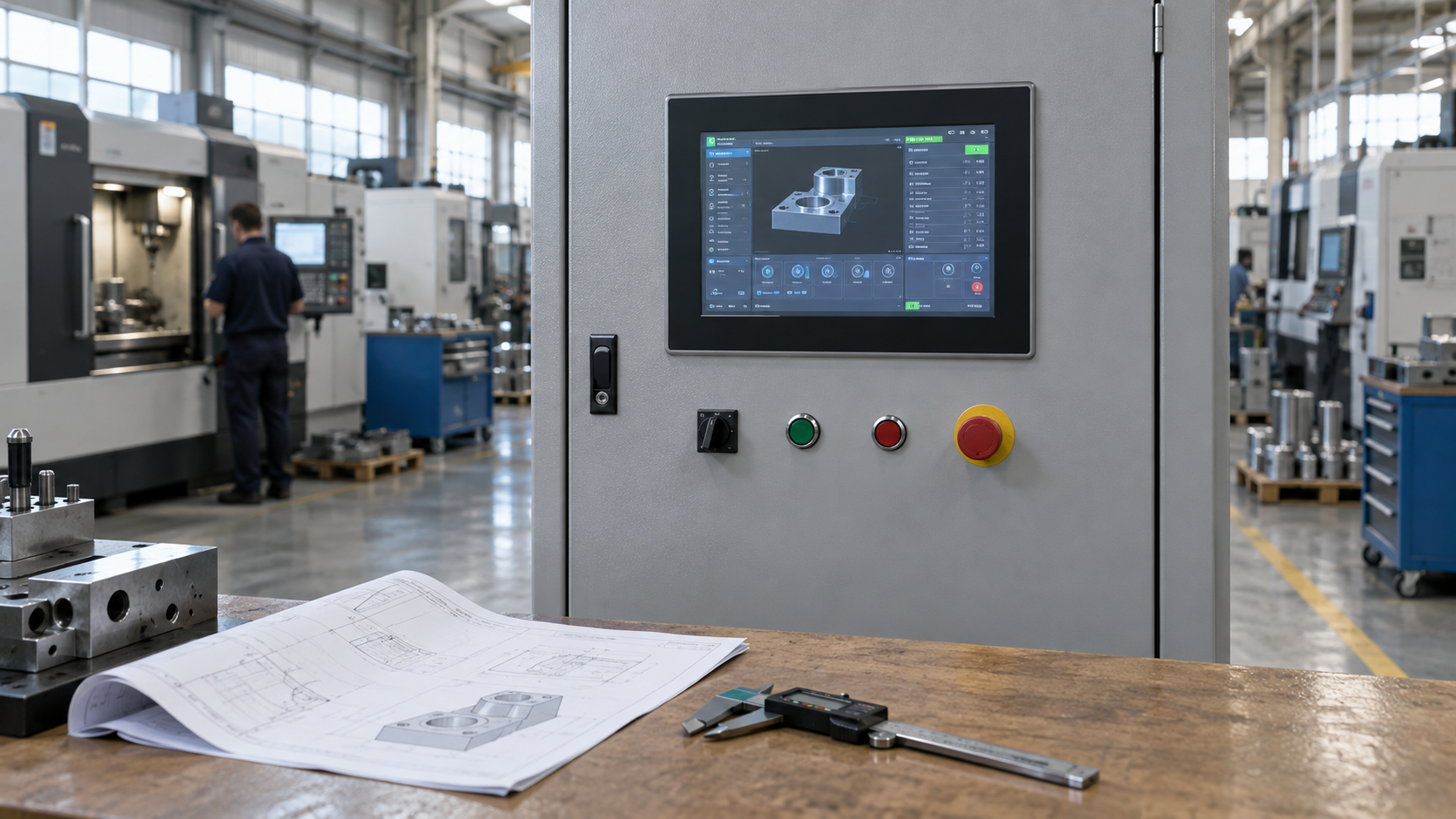
Two 10.1-inch panels can sit next to each other on a quotation with matching headline figures (1024 × 600, 500 cd/m², IPS, capacitive touch, Android) and behave nothing alike once they are running. Same diagonal, entirely different window shape. One is laid out wide, the other tall. That difference never turns up among the feature bullets at the top of the page. It turns up in a dimensional drawing further down, usually after the enclosure has been cut.
Start with the drawing, not the feature list
Four measurements settle whether a panel fits, and suppliers name them differently. Outline is the outside edge. Cutout is the hole in your sheet metal. Active area, often written AA, is the part that actually glows. Thickness moves with configuration, which is where quotations quietly diverge.
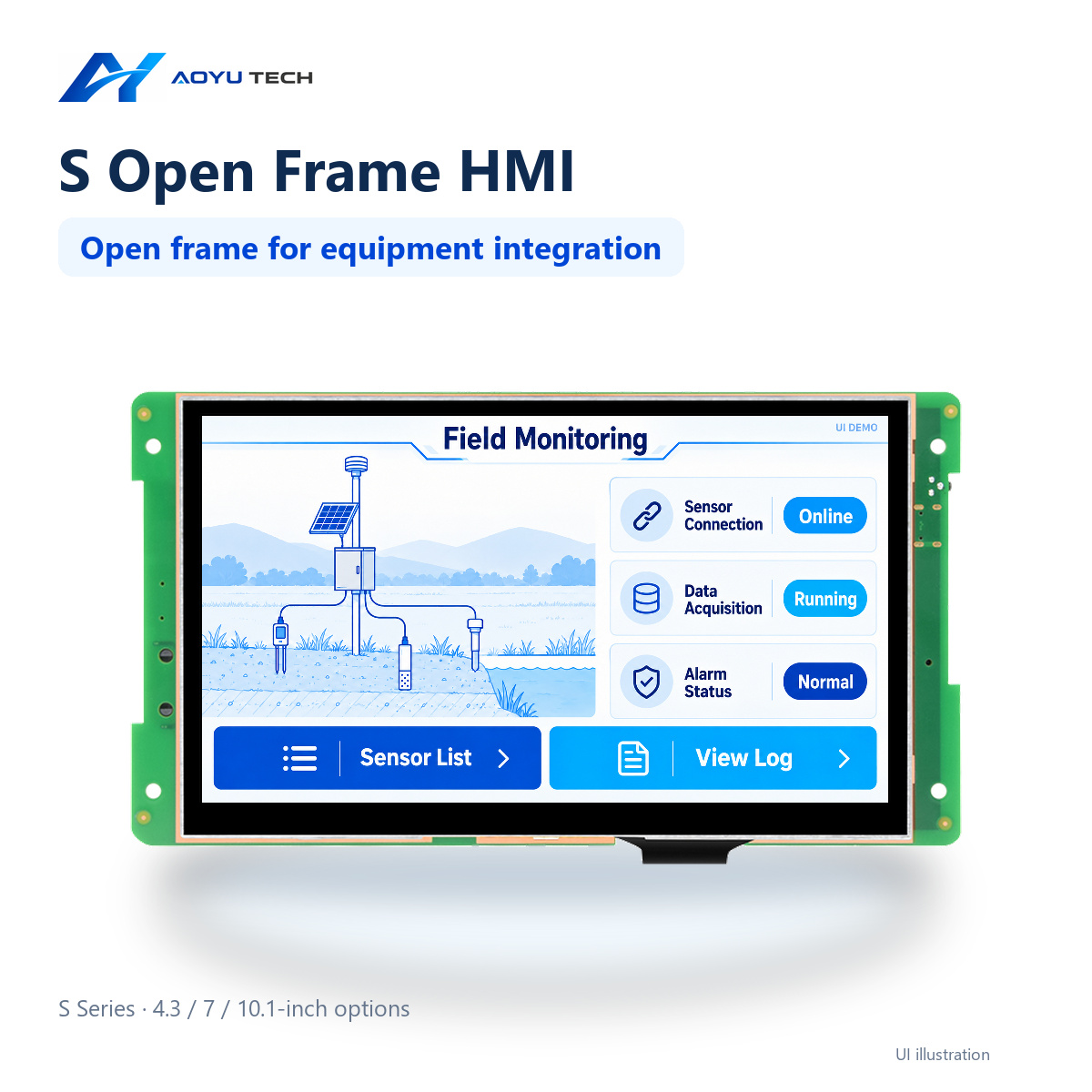
The open-frame S series gives a clean example. Its 7-inch model measures 191 × 105.5 mm overall, needs a cutout of 165.9 × 100.9 mm, and its active area is 154.21 × 85.92 mm. Three thicknesses are listed for the same nominal size, 22.8, 22.1 and 20.3 mm, because the stack changes with touch and cover options. Design around the thickest and you lose nothing. Design around the thinnest and a later revision may not sit flush.
Active area deserves its own check, since diagonal inches hide aspect ratio. The 10.1-inch S series panel has an active area of 222.72 × 125.28 mm at 1024 × 600. The 10.1-inch unit in the industrial edge B series runs 800 × 1280, a taller, narrower window on the same diagonal. Your interface layout notices that before your cabinet does.
Brightness describes where the panel starts
500 cd/m² is standard across most industrial ranges, ours included. Several series offer 1,000 cd/m² as a build option, among them the P series and the B series. IPS tells you how colour shifts with viewing angle. Neither line says anything about sunlight, since outdoor readability depends more on reflection than raw output. We covered that in sunlight-readable HMI panels and optical bonding.
Temperature is two lines, not one
Operating range and storage range sit adjacent and get read as one number more often than you would expect. In the S series the figures are −10 to 60 °C operating and −20 to 70 °C storage, with humidity to 95 per cent, non-condensing. The die-cast F series integrated panel is rated −20 to 70 °C and carries an explicit note for operation around the clock.
That note is what to look for. A temperature range with no statement about duty cycle may have been qualified for intermittent use, and nobody volunteers that unasked. Cold starting deserves a question too. Liquid crystal thickens as it cools, so a panel that behaves well by mid-morning can leave the first operator of the day waiting on a sluggish refresh in an unheated building. We wrote more on this in heat, cold and dirty power.
Count the connectors, not the channels
The IO table is where most order revisions are born. The B series edge panel lists ten RS485 channels in total, two RS232, eight digital inputs, four digital outputs, four analogue inputs and two CAN interfaces. The physical breakdown then shows a DB9 carrying two RS232 and two RS485, eight RS485 on a rear connector, three USB ports on the side and one Type-C OTG in front. The numbers add up, but they sit behind different connectors, and your harness may not reach all of them.
Power lines work the same way. The S series takes 12 V nominal within a range of 12 to 24 V and draws under 3 W running. The B series spans 12 to 48 V, adds reverse-polarity protection, and isolates serial ports, CAN, IO and its 12 V outputs from the rest of the board. PoE is listed against one port, LAN0, rather than whichever jack your cable route favours.
The standard number is the claim
A line reading "EMC Level 3" means little without saying what it was measured against. Our S series documentation cites EN 55035 and EN 61000-4-2, with a 7-inch sample tested at 230 V and 50 Hz, 23.2 °C, ESD applied at 6 kV contact and 8 kV air, reaching Level 3 at Class B. Every clause narrows the claim, as it should.
IEC 61000-4-2 sets four severity levels, from 2 kV contact and 2 kV air at Level 1 up to 8 kV contact and 15 kV air at Level 4. Level 3 is 6 kV contact, 8 kV air, and is what most industrial sites specify against. The performance class beside it carries equal weight. Class A means the device stayed within its limits throughout. Class B allows temporary degradation that recovers by itself. Class C permits a loss of function needing an operator or a reset. Class B is routine for a monitoring screen. Where the panel fronts anything safety-related the integrator usually wants Class A, and asking early costs less than asking later.
Convert the lifetime figures first
Service life arrives as a symbol and a round number, easy to skim past. The S series lists backlight life at 20,000 hours or more and touch operation at one million touches or more. Twenty thousand hours is roughly 2.3 years running every hour of every day, or nine to ten years on single-shift work. A million touches at 200 operations a day, 250 working days a year, lands past twenty years. In practice the backlight is what you deal with first.
The definition behind the hour count is worth one email. Much of the industry defines backlight life as the point where output falls to half its original value, and the panel keeps working long past that, just dimmer than when it started. Some suppliers pick another threshold, and without knowing which, two panels quoting identical hour counts are not comparable.
Touch endurance assumes something about what touches it. A fingertip, a gloved hand dragging sideways and a hard stylus tip wear the same surface differently.
What one model number can hide
A part number often covers several mainboards, and the sheet usually prints the best case. The die-cast F series 7-inch ships in three configurations: an RK3568 with four Cortex-A55 cores at 2.0 GHz, 2 GB of RAM, gigabit Ethernet, Android 11, plus Linux Buildroot, Debian 10 and Ubuntu 18.04; an S905D3 at 1.9 GHz with 1 GB, 10/100 Ethernet and Android 9.0; and an A133 at 1.6 GHz with 1 GB, Android 10, Ubuntu 18.04 or Linux QT. Ethernet speed, OS version and Linux support move together. Two quotations for one model number can differ more than quotations for two different models.
Integration detail does not appear on the summary page either. Silent installation, OTA updates, watchdog behaviour and shell access arrive in a separate document, usually once somebody asks.
Six lines for the enquiry
- Outline drawing, cutout, active area and thickness of the exact configuration quoted.
- Operating temperature at the installation, and whether cold starts happen daily.
- Input voltage range, reverse-polarity protection, isolated lines.
- Connector types and channel counts behind each.
- EMC standards with revision, levels applied, performance class reached.
- Backlight life definition, available OS versions, and whether the model stays orderable for the life you need.
Suppliers with straight answers reply within a day. When they do not, the follow-up questions tend to teach more than the datasheet did.
If two sheets in front of you disagree, send us both. We will say which lines on our own sheets need qualifying. Start at the inquiry page, or go to the model in question: S series open-frame 7-inch, B series edge controller, F series die-cast integrated panel, and P series interactive 10.1-inch.
Related products
Explore our HMI panels
S-070 7-inch HMI Panel
Size: 7 inches. Resolution: 1024 × 600 px. Backlight brightness: 500 cd/m². Viewing angle:…
View product →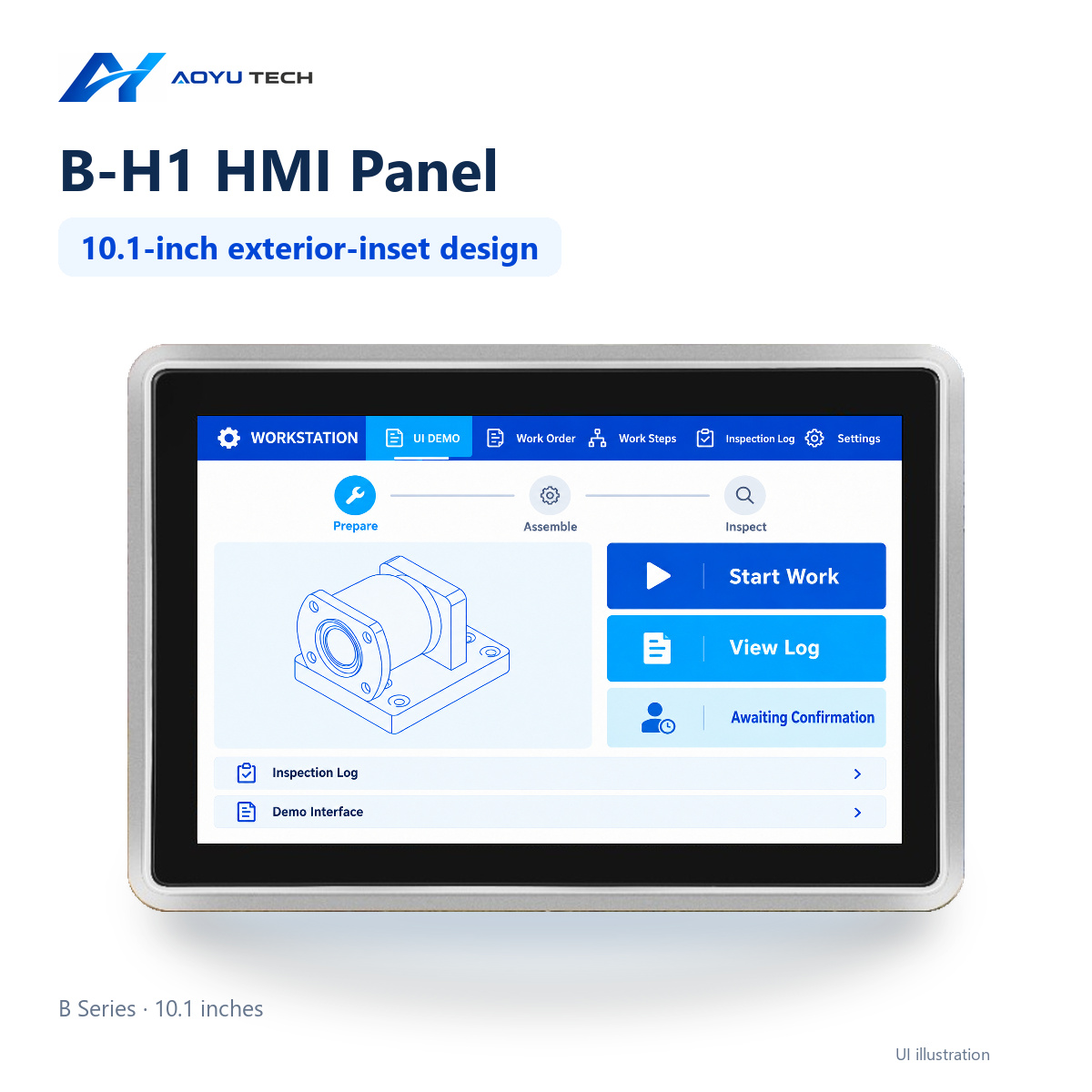
B-H1-101 10.1-inch HMI Panel
Frame material: Plastic. Frame color: Silver / Black / White. Mounting methods: Exterior i…
View product →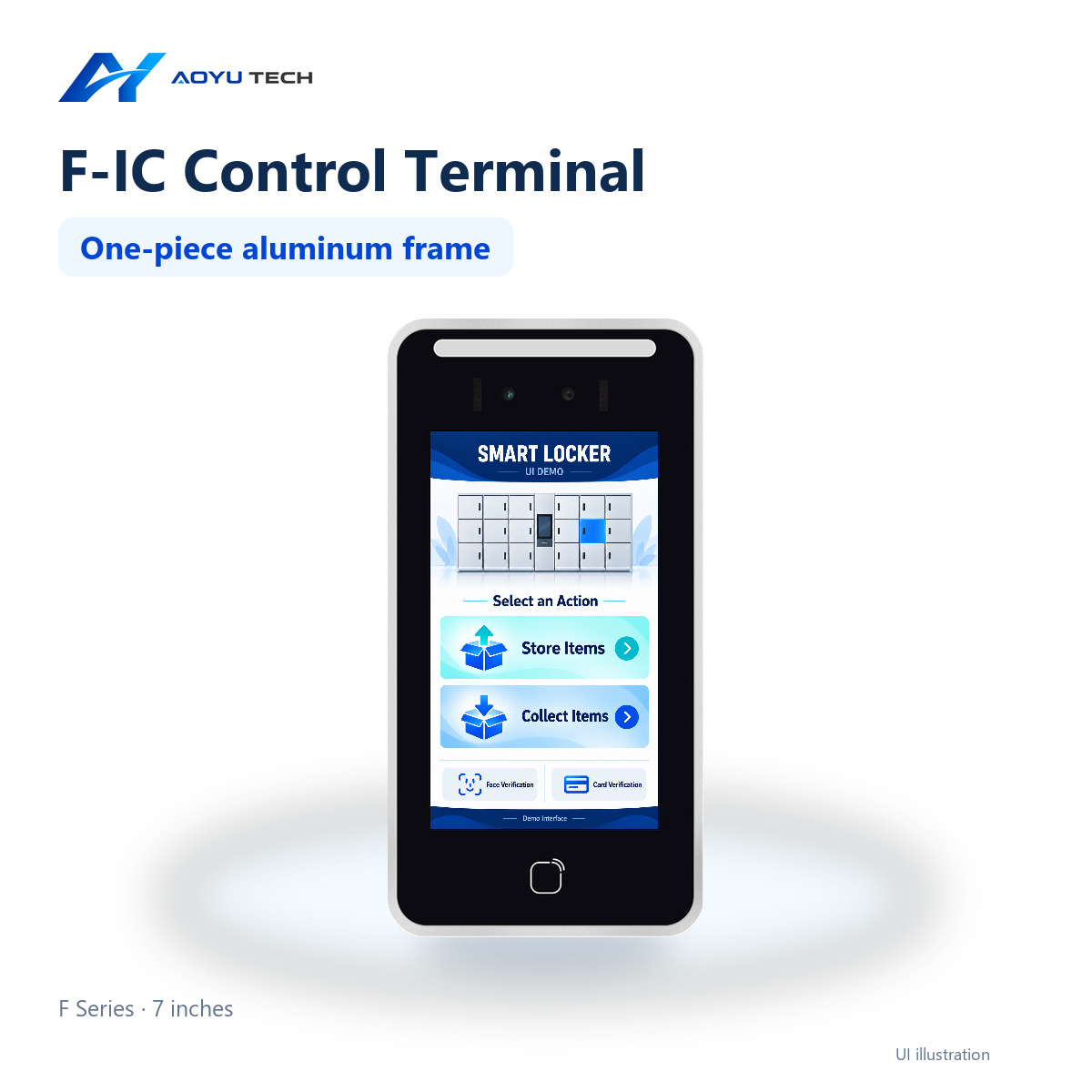
F-IC-7 7-inch HMI Panel
Material: Die-cast aluminum alloy. Mounting methods: Exterior inset mounting. Front panel …
View product →Ready to start your HMI project?
Our engineers help you choose the right HMI hardware and software for your project.