
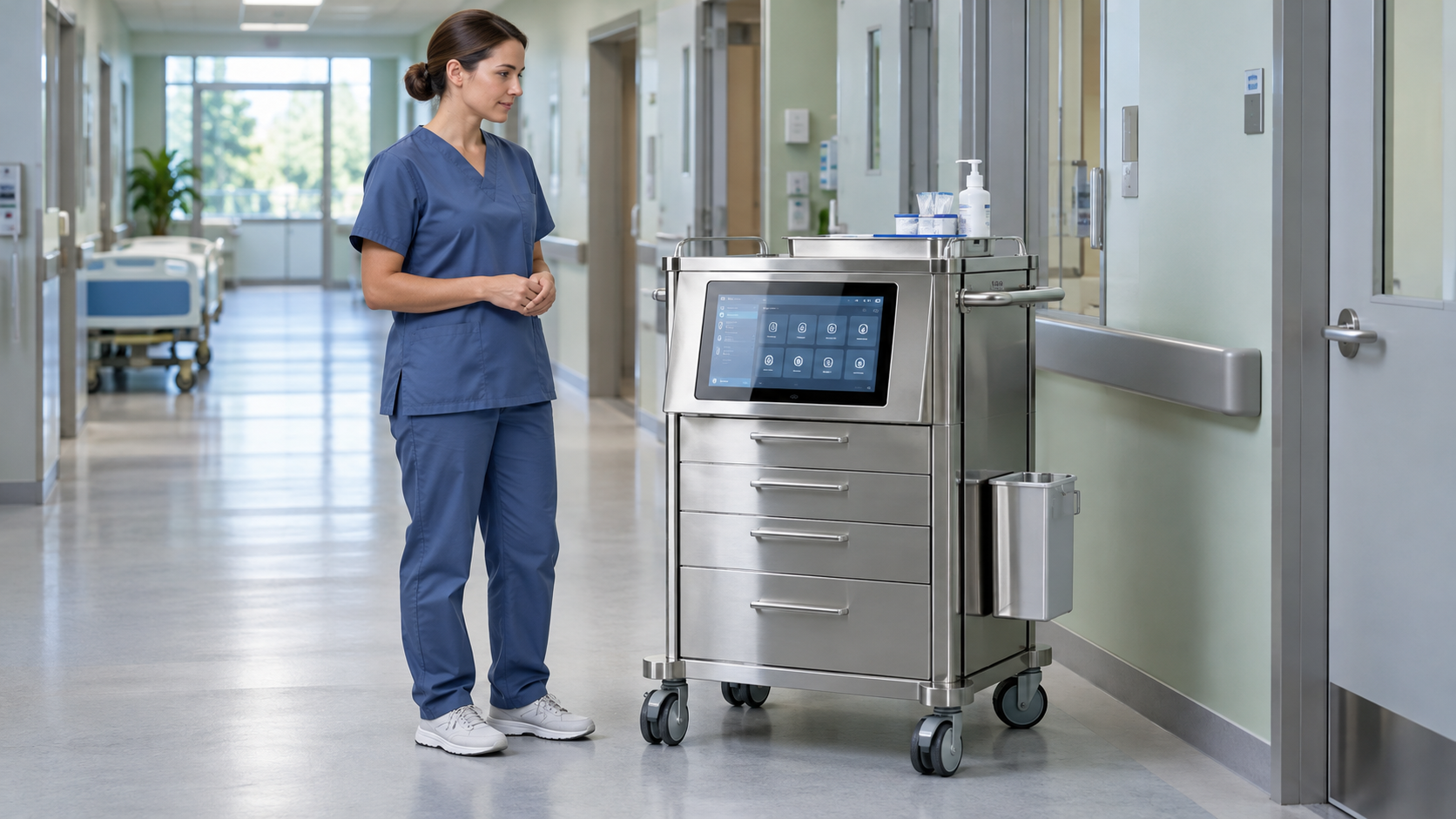
A screen on an infusion pump gets wiped several times an hour, with whatever agent the infection control team signed off this quarter. Between those wipes, somebody wearing nitrile gloves taps it. Two feet away sits another device that the hospital expects to keep running through all of it. Standard panel data sheets say nothing about any of this.
We build touch panels and ship them as components to equipment manufacturers, which is the side of the wall this is written from. Certification and intended use belong to the device maker and their test house.
The panel is a part, not a certified device
A component supplier does not hold your technical file and cannot tell you your machine is compliant. What we can hand over is narrower but useful: construction drawings, material declarations, platform test reports, measured thermal behaviour under a stated load, and notice when anything inside the box changes.
That last item is the one people forget. Agree it before design freeze, not after, and get it in writing.
Treat "medical grade" as advertising until a test report appears beside it. The report should name a standard, an edition and a date.
Cleaning agents eat finishes
Hospitals rotate disinfectants, and the roster shifts when supply runs short. Common agents include isopropyl alcohol around 70 percent, diluted sodium hypochlorite, hydrogen peroxide wipes and quaternary ammonium compounds. Each attacks something different: printed logos first, then sprayed coatings, then some bezels that craze after long exposure.
Anti-glare surfaces deserve a specific question. Glass that has been chemically etched keeps its matte behaviour because the structure sits in the glass itself. A sprayed layer on top can haze, turn patchy, or wear off where hands rest most.
Construction matters as much as chemistry. A flat front without recessed screws or overlapping edges leaves less for fluid to sit in, and where the touch sensor is bonded to the cover glass rather than separated by a gasket and an air gap, there is no internal seam for liquid to follow. That is also why people move to higher ingress ratings, though the rating alone will not tell you whether a wipe solution hazes the glass.
Ask something specific instead: here is my list of agents and concentrations, test them against the finish you intend to ship. A generic claim of chemical resistance says nothing about your protocol.
Gloves, fluids and false touches
Touch tuning is a trade, not a setting you can max out. Raise sensitivity enough to read a thick nitrile glove and the same controller starts reading droplets, a film of cleaning fluid, or the side of a hand brushing past.
Specify glove material and thickness, and whether hands may be wet. Procedure gloves are thicker than the thin nitrile used for routine care, and that difference changes the answer. Background on the wider trade-off sits in our piece on capacitive and resistive touch.
Sample testing with the actual gloves settles it faster than discussion.
EMC is about the neighbours
Panels here are judged less on what they survive than on what they emit beside other equipment. IEC 60601-1-2 edition 4.1, published in September 2020, sets immunity test levels by intended use environment: professional healthcare facilities, home healthcare, and special environments. It also introduced testing for portable radio equipment held closer to the device than earlier editions assumed. Radiated immunity is commonly specified at 3 V/m from 80 MHz to 2.7 GHz, and enclosure port ESD points to IEC 61000-4-2, usually quoted at ±6 kV contact and ±8 kV air. Verify those figures against the edition your lab works to, including any national deviation.
There is geometry work that helps on our side. A metal chassis gives noise a low-impedance path, apertures stay small, and I/O gets filtered where it leaves the enclosure. The C-101 mechanical drawing carries a grounding stud for exactly this reason: engineers wanted somewhere to land a strap.
Then the honest limit. We can measure emissions for a platform on a bench. Whether the assembled device passes, with its own cables, sensors and power supply, is a test only the integrator can run.
Heat has to leave without moving air
Hospital procurement specs often ask for fanless. Dust control, night noise in occupied rooms, and one less moving part that eventually stops. Passive cooling then carries the whole load through the housing.
A one-piece die-cast aluminium shell helps. It conducts heat to the outer surface instead of pushing it through vents, which is why the F-IC-7 is built that way rather than as a plastic box with slots. The cost shows up elsewhere: fanless designs throttle sooner under sustained load, and backlight output has to be chosen with that in mind. The same trade-off runs through any wide temperature discussion.
Allowable touch temperature comes out of the device maker's risk management under IEC 60601-1. We supply measured case temperatures at a defined load and ambient. Turning those into a limit is not ours to decide.
Once it is certified, the bill of materials is frozen
A device that has cleared testing is difficult to change. Swapping the LCD, moving to another touch controller, or even shifting a driver version can reopen assessment, and calendar time costs more than money here.
Before freeze, agree how long the configuration stays available, how much notice you get when it changes, and what happens if a part goes obsolete. Then pin it in your documentation: controller ID, firmware build, board photographs. Our walkthrough of an OEM/ODM project covers where those decisions lock.
Which formats get specified most
Three shapes cover most of what we ship into this kind of work.
Boards and open-frame modules go into the equipment housing, where the outer shell is part of your industrial design. The C-101 is a 10.1-inch unit in that group: 500 cd/m² IPS panel, a stated operating range of -20 to 70 °C, and a drawing that shows the grounding stud.
Flush-mounted larger panels suit ward terminals and diagnostic consoles. The P-X2-156 and P-X2-215 are front-embedded at 15.6 and 21.5 inches, 1920 × 1080, with 250 cd/m² standard and 500 or 1000 cd/m² where lighting asks for it. Both take VESA 100 × 100, and selected configurations include Gigabit Ethernet.
Small sealed units end up on carts and cabinets, often with an identification step attached. The F-IC-7 is a 7-inch panel with an IP65 front, offering RFID and a two-megapixel dual camera as options. On wheeled equipment the 10-inch B-H1-101 comes up too: 75 × 75 VESA and a 12 or 48 V input suit cart wiring better than a mains adapter.
Not a recommendation. Environment, workload and the standards you are testing to decide which fits. We would rather work through the requirements than have you pick from a table.
What to send with the enquiry
Useful starting material: cleaning agents and concentrations, glove type and thickness, whether hands may be wet, the applicable EMC standard and edition, target markets, whether fanless is mandatory, expected service life and volumes. If the device is certified already, tell us what went through testing.
Send that through our enquiry page and we will come back with options plus the documentation behind them, including where a stock configuration stops being the right answer.
Related products
Explore our HMI panels
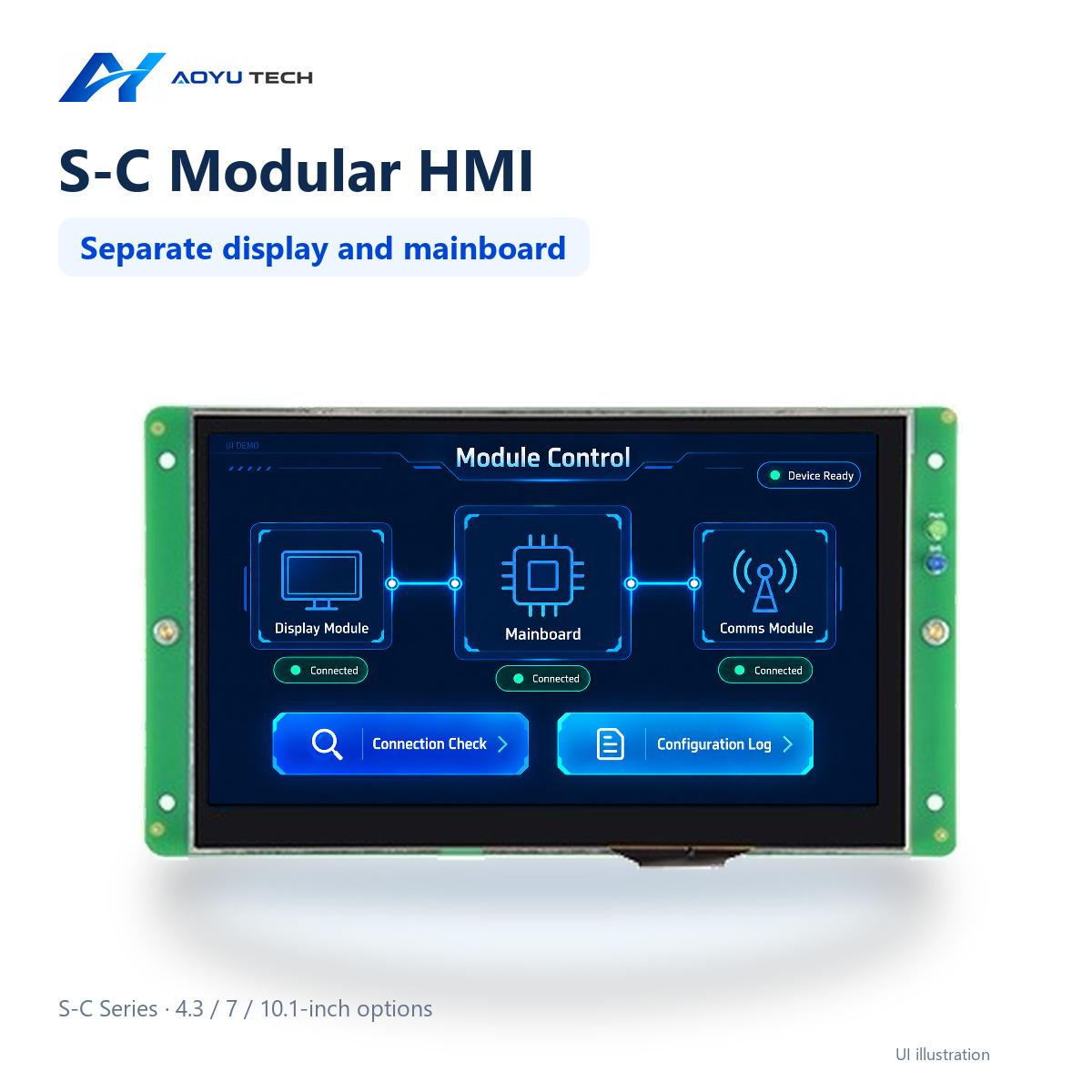
C-101 10.1-inch HMI Panel
Display size: 10.1 inches. Backlight brightness: 500 cd/m². Viewing angle: IPS. 10.1-inch …
View product →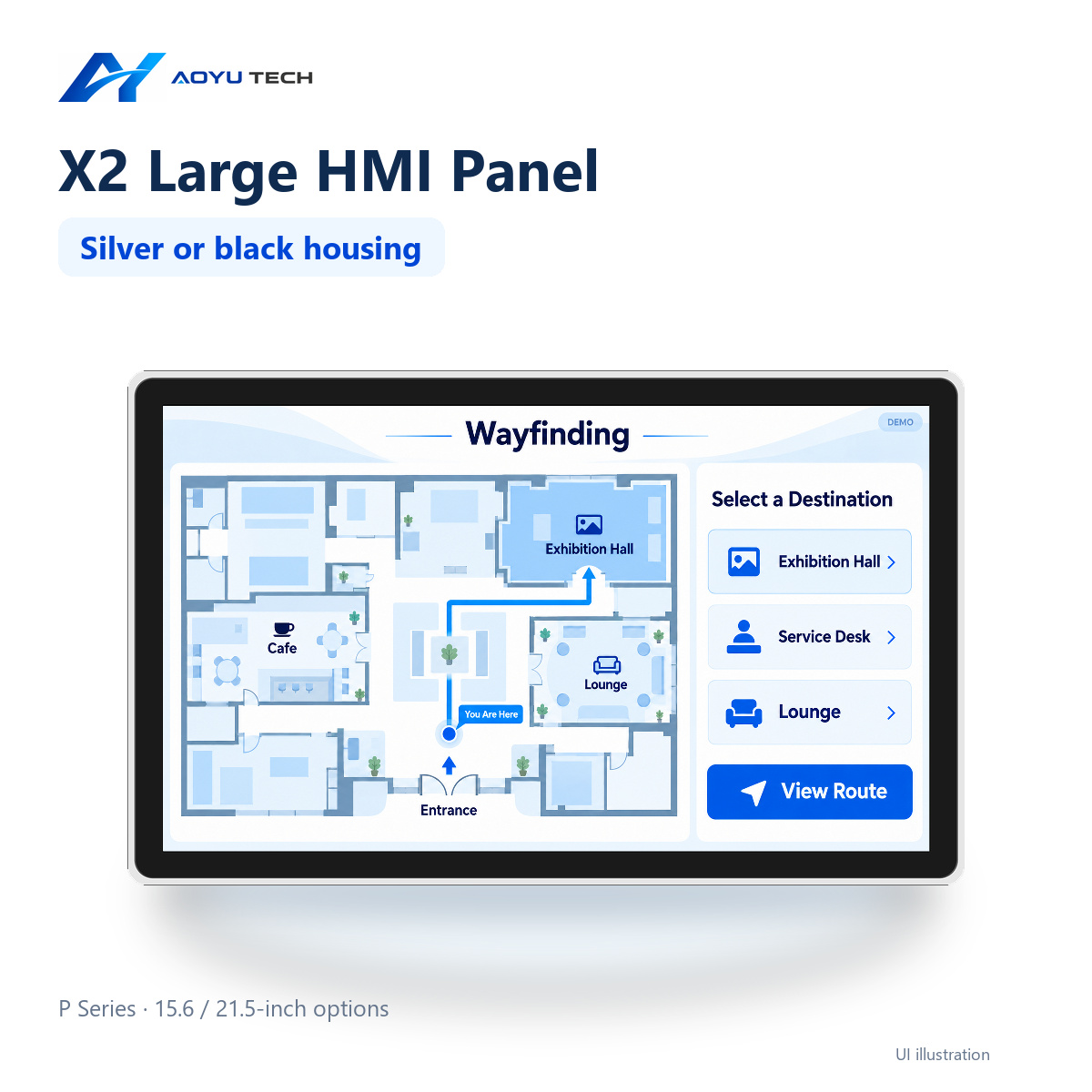
P-X2-156 15.6-inch HMI Panel
Display size: 15.6 inches. Resolution: 1920 × 1080 px. Brightness: standard: 250; optional…
View product →P-X2-215 21.5-inch HMI Panel
Display size: 21.5 inches. Resolution: 1920 × 1080 px. Brightness: standard: 250; optional…
View product →Ready to start your HMI project?
Our engineers help you choose the right HMI hardware and software for your project.