
Hitachi and Fanuc join up on physical AI for factory lines
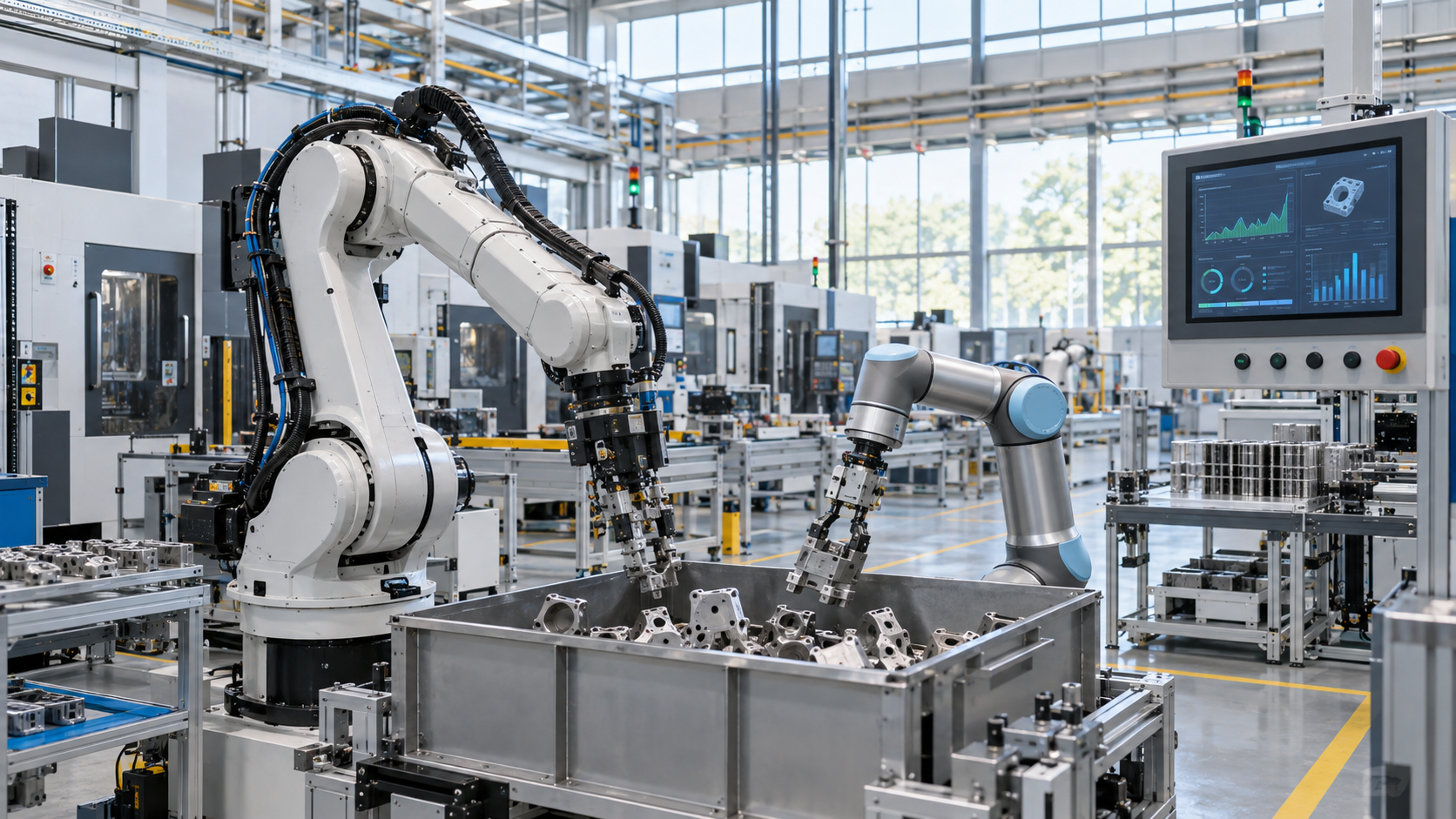
Hitachi and Fanuc signed a strategic partnership to develop and commercialize physical AI systems for manufacturing, according to a joint statement released on September 30. Hitachi contributes its HMAX Industry platform and its own edge AI semiconductors; Fanuc brings industrial robots, control systems and robotics AI. Hitachi plants in Japan's Ibaraki Prefecture will serve as "Customer Zero" sites, where the two companies plan to measure recognition accuracy, robot motion, takt time and quality on jobs such as picking irregularly shaped parts out of a bin and switching a line over between products. Commercial rollout is scheduled from fiscal 2027 across nine sectors: semiconductors, automotive, pharmaceuticals, healthcare, advanced materials, logistics, food, shipbuilding and agriculture. Neither company disclosed a transaction value. (Sources: The AI Insider, Automation News, IBTimes Japan)
OpenAI decides not to ship GPT-6.1 Astra
OpenAI confirmed on September 29 that it will not release GPT-6.1 Astra, its next frontier model, judging that the model did not meet the company's internal safety bar. Saachi Jain, who heads OpenAI's safety systems, said the company holds itself to a high standard on safety and alignment at the point a model reaches users. The call lands a week after Anthropic CEO Dario Amodei published an essay urging labs to slow the pace of frontier releases. Anthropic shipped two models in the same period, Opus 5.5 on September 22 and Sonnet 5.5 on September 29. (Source: Cailian Press)
Anthropic ships Claude Sonnet 5.5 with a large jump in coding scores
Anthropic released Claude Sonnet 5.5 on September 29, the second model in its Claude 5.5 family. The company says it runs more than 30% faster than Sonnet 5 and cuts task cost by as much as 30%, even though list pricing is unchanged at $2 per million input tokens, $10 per million output tokens and $0.20 per million cached tokens read. On Terminal-Bench 4.0, a coding benchmark, Sonnet 5.5 scored 70.6% against 10.3% for Sonnet 5, and Anthropic says it beats Opus 5.5 on agentic coding tasks. It is also the first Sonnet model to ship with the cybersecurity safeguards Anthropic built for its heaviest models. The model runs on Claude and through AWS, Google Cloud and Azure. A Haiku 5.5 is due in the coming weeks. (Sources: Gelonghui, Citnews)
Nvidia says GPT-6 Astra Ultrafast runs on Blackwell
In an October 1 post, Nvidia said the Ultrafast tier of OpenAI's GPT-6 Astra runs on its Blackwell GPUs and generates tokens up to eight times faster than Astra Standard. The service is available through the OpenAI API and to eligible ChatGPT Work and Codex users. Nvidia framed the gain as inference optimization around its silicon rather than a change to the model family, and published no benchmark conditions or comparison against rival accelerators. Philippe Tillet, OpenAI's inference lead, said Nvidia's tooling has made OpenAI's models good at programming Blackwell and Rubin GPUs; Uday Ruddarraju, OpenAI's CTO of compute, said the two companies are also using OpenAI's own models to tune the inference stack. (Sources: Ontime Brief, International Business Times)
Micron extends its HBM tightness warning to 2028
Micron beat expectations on revenue and profit in its fiscal fourth quarter, and used the occasion to say something longer term: HBM supply will be tighter in 2027 and 2028 than it is in 2026. It is the first time the company has pushed that guidance out two years. Micron Taiwan chairman and Asia DRAM front-end manufacturing vice president Donghui Lu confirmed on October 2 that AI demand is driving simultaneous expansion at four sites in Taiwan, China: Taoyuan, Taichung, Tongluo and Tainan. A second HBM advanced packaging facility in Taichung is due to come online in October 2026. Counterpoint Research put second-quarter HBM share at SK Hynix 50%, Samsung 32% and Micron 18%. (Sources: TrendForce, Wallstreetcn)
China starts work on a mandatory agent security standard
China's standardization regulator has approved a project for a compulsory national standard titled "Basic security requirements for agent applications," project number 20263116-Q-252, managed under the Cyberspace Administration of China and drafted with China Mobile as lead. Communications World reported the project approval on October 3 and called it the first mandatory national standard anywhere aimed specifically at agent security, filling a gap for public-facing services. The report argues that risk has moved from the output layer to the action layer: an agent with network access and credentials can leak data by sending it to the wrong place, misuse a tool, or be talked into a high-risk operation. Once in force, a mandatory national standard becomes a legal threshold rather than a recommendation. (Source: Communications World)
Washington signs a voluntary accord and names an AI lead
Reuters reported on October 3 that six companies, Nvidia, SpaceX, OpenAI, Anthropic, Meta and Google, had signed a voluntary set of frontier safety commitments with the Trump administration. The accord sets out no penalties for noncompliance, leaving enforcement to company-level oversight. On September 29, President Trump signed an executive order directing federal departments and agencies to use the term "superintelligence" in place of "artificial intelligence," and hosted tech executives at the White House the same day to sign the accord. The Wall Street Journal reported on October 3 that Trump had named Director of National Intelligence Jay Clayton as White House AI lead, heading a superintelligence task force that has 120 days to report on AI risks and opportunities. A Reuters/Ipsos poll published September 22 found three in four Americans worried that AI companies are not doing enough to prevent serious harm. (Sources: Securities Times, Reuters via AI governance Brief)
China installed 354,000 industrial robots in 2025, IFR says
The International Federation of Robotics released its World Robotics 2026 report on September 24. In an interview carried by People's Daily Overseas Edition on October 1, IFR Secretary General Susanne Bieller said China held its position as the largest industrial robot market in 2025 with 354,000 units installed, roughly 59% of the global total and a record. Bieller said Chinese suppliers are turning out products matched to specific production needs faster than before, and that robots are becoming the main way AI reaches real production environments, with physical AI the direction she expects to carry the industry forward. She visited a Chinese EV plant in Shenzhen in April where humanoid robot work runs alongside conventional industrial robots. (Source: People's Daily Overseas Edition)
Productive Robotics puts a scanning cobot on CNC tending
Productive Robotics introduced OB7-AI on October 1 at IMTS 2026, a seven-axis collaborative robot built for CNC machine tending. The arm scans a machine's work area to work out where everything sits, so blanks no longer have to be placed precisely on the table; as long as there is finger room between parts, the gripper can reach them. It opens the door, loads the vise, closes the door and presses start, then reads the CNC screen to work out when the cycle has finished before unloading. Company president Zac Bogart said no AI training cycles are needed for new parts or tasks, and pointed at automotive and CNC machining as the main markets. (Source: Industrial Machinery Digest)
Ready to start your HMI project?
Our engineers help you choose the right HMI hardware and software for your project.