
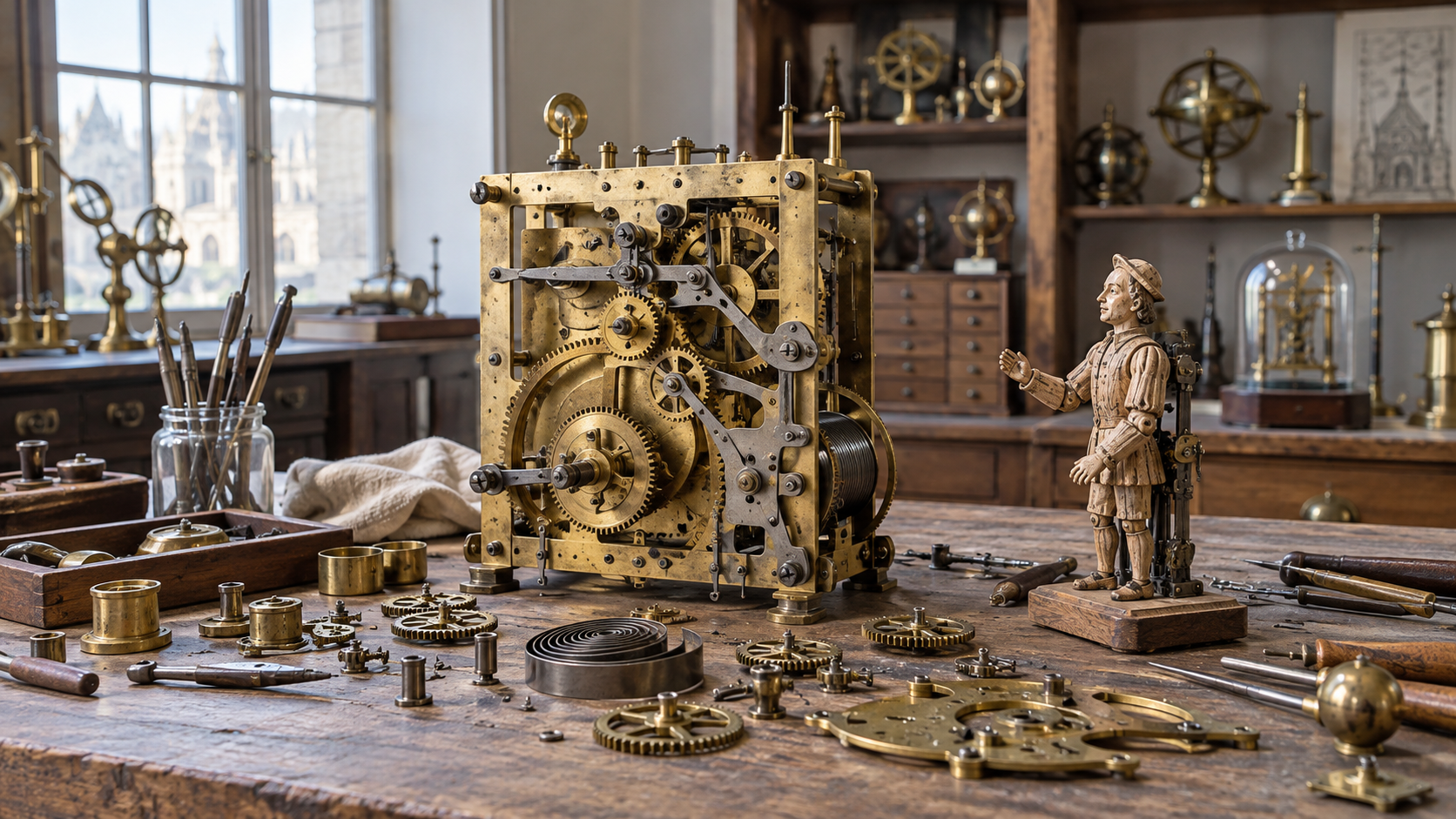
Hero of Alexandria described a machine in the first century AD that no Roman workshop had a use for: a box with a slot in the top, a pan hung on a lever, and a valve. Drop in a five-drachma coin and the weight tips the lever, opening a valve until the coin slides off into a collection box and a counterweight pulls the lever back. Temples wanted it because worshippers took more than they paid for (Greek Reporter). Hero also described the aeolipile, a sphere over a boiler that spun as steam escaped through two bent nozzles. Nothing was ever driven by it (Missed History).
An earthquake detector that beat the courier
Zhang Heng built a bronze vessel in 132 AD with eight dragons around the rim and a bronze ball in each dragon's mouth. The Hou Hanshu records that in 138 a ball fell from the dragon facing the northwest while nobody in Luoyang felt a thing; days later a rider came in from Longxi, a thousand li away, with news of an earthquake. The instrument vanished around the end of the Han, and everything on display since is a reconstruction: Wang Zhenduo's 1951 model, built from a description of fewer than two hundred characters, and a 2005 one by seismologist Feng Rui's team, built around a suspended pendulum. (China Digital Science and Technology Museum).
A carriage that kept pointing south
Chinese records describe a two-wheeled ceremonial cart with a wooden figure on top whose arm held one direction however the vehicle turned. The fullest surviving specification, in the Song shi, comes from Yan Su's machine of 1027: two road wheels feeding a train of seven gears, the figure held steady by the difference between how far each wheel travels through a bend. That is a differential gear, the arrangement that lets a car's outer wheel run faster around a corner. No original has been found. George Lanchester built a working differential model that the British Museum holds. (China Science Communication, Wikipedia).
A flute you could reprogram, in ninth-century Baghdad
The Banu Musa brothers, three engineers in ninth-century Baghdad, filled the Book of Ingenious Devices with around a hundred machines. One is an automatic flute player driven by steam, with interchangeable cylinders that set which notes come out and in what order. Swap the cylinder and you change the tune, an idea that later travelled by punched card. They also described a conical valve, among the first automatic flow controllers (Wikipedia, Histoire IA).
Water, gears and a tower in Kaifeng
Su Song finished a wooden pilot model of his astronomical clock tower in 1088 and the bronze version by 1094, in Kaifeng, then the Song capital. Water filled scoops on a wheel and tipped them one at a time, each tip letting the wheel advance a step. His 1092 book Xinyi Xiangfayao carries the oldest known drawing of an endless power-transmitting chain drive, and Joseph Needham called the escapement a forerunner of the European anchor escapement, which followed six centuries later. In 1127 the Jurchens took Kaifeng, dismantled the tower and hauled it north, where nobody could reassemble it (Bionity, citing Needham).
Pegs, cams and a band on a lake
Ismail al-Jazari, chief engineer at the Artuqid palace in Diyarbakır, completed the Book of Knowledge of Ingenious Mechanical Devices in 1206. One entry is a boat with four mechanical musicians on a palace pool: water fills a tipping bucket over about half an hour, the bucket empties onto a scoop wheel, and pegs on the axle lift the musicians' arms. Move the pegs and the drummer plays a different pattern, which is why Noel Sharkey calls it the first programmable robot. (aljazaribook.com).
A duck that ate
Jacques de Vaucanson showed the canard digérateur in France on 30 May 1739: life-sized, gilded copper, taking grain from a hand and producing what looked like digested waste. Voltaire wrote in 1741 that without Vaucanson's duck there was little left to remind you of the glory of France. There was no digestion. Jean-Eugène Robert-Houdin examined the mechanism in 1844 and found the droppings were breadcrumb pellets dyed green. The Belgian artist Wim Delvoye built a machine that really does it in 2006 and called it Cloaca (Wikipedia).
A box that spoke
Wolfgang von Kempelen spent twenty years on a speaking machine and published Mechanismus der menschlichen Sprache in Vienna in 1791. The operator worked a bellows with the right forearm, standing in for lungs, while air passed an ivory reed acting as vocal cords and then into a rubber mouth whose resonance the left hand changed. It was the first machine to get past isolated sounds to whole words and short sentences, The final version sits in the Deutsches Museum in Munich and still works (Columbia University).
A turbine with no blades
Tesla patented a turbine in 1913, US 1,061,206, that replaces blades with a stack of smooth discs on a shaft inside a cylindrical housing. Steam or water enters at the rim and spirals inward to a central exhaust, dragging the discs around through viscosity and adhesion. In practice it managed around 40 per cent efficiency where Tesla had calculated more than 95, and the discs warped under heat, so production never happened (Google Patents).
A desk that linked things
Vannevar Bush published "As We May Think" in The Atlantic in July 1945, having run the US Office of Scientific Research and Development through the war. The memex he described was a desk holding microfilm reels, viewers and cameras for a person's books, records and correspondence. What mattered was associative indexing: build a trail linking one item to another, and recall the whole trail later. Doug Engelbart read the essay soon after it appeared and traced to it the work that produced the mouse (Centre for Computing History).

Ready to start your HMI project?
Our engineers help you choose the right HMI hardware and software for your project.