
Some places look retouched in photographs, and no explanation quite fixes that first impression. What separates them from a clever edit is paperwork: instrument readings, park surveys, journal papers. Each of these comes with a source you can check.
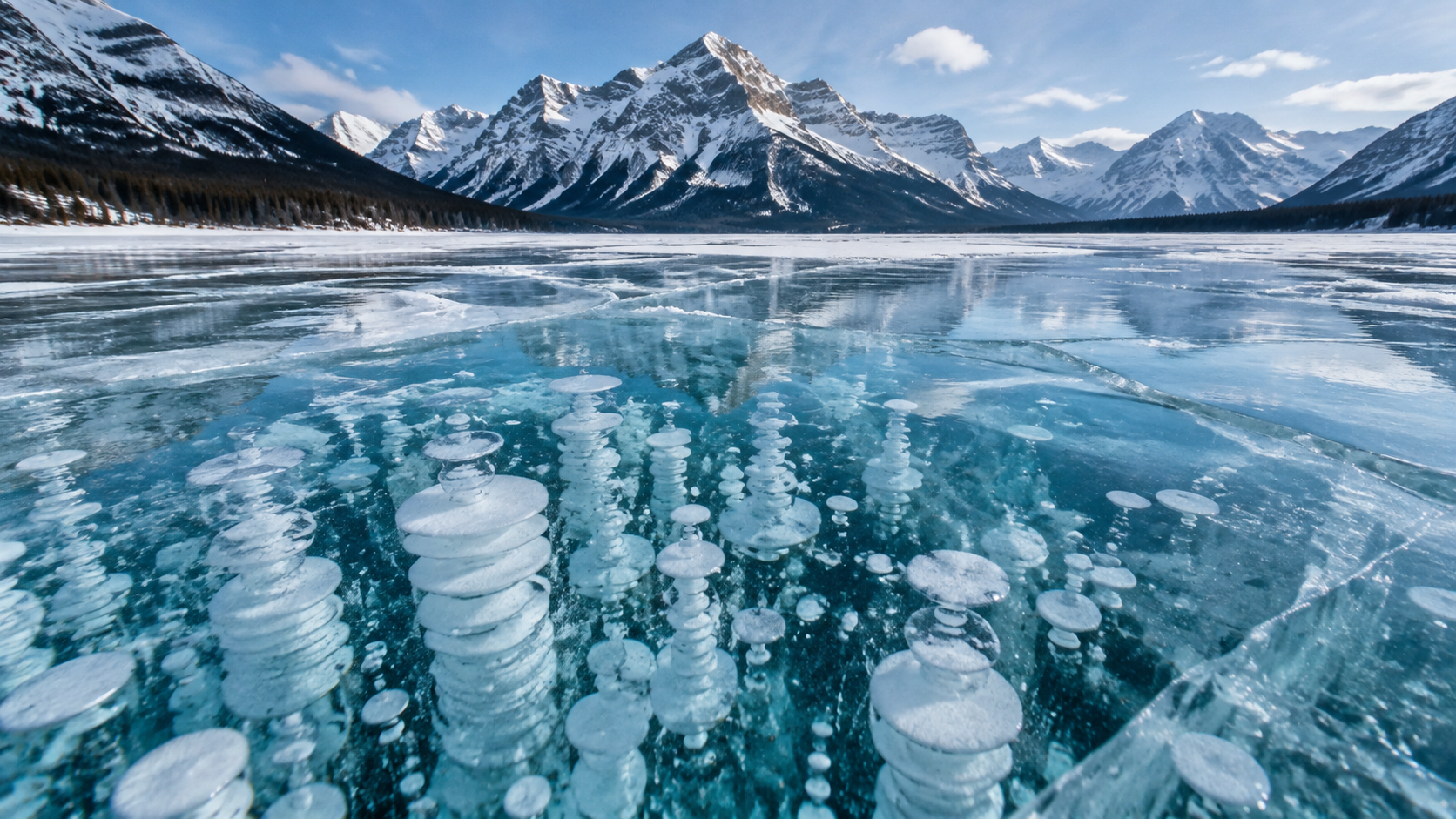
Bubbles frozen on the way up
Abraham Lake in Alberta was created in 1972 when the North Saskatchewan River was dammed, and the reservoir drowned a lot of vegetation. Bacteria on the bottom eat it and give off methane. In summer the gas reaches the surface and pops; in winter it is caught on the way up and held in the ice as the sheet thickens, leaving milky columns stacked one above another. Wind keeps scouring the surface unusually clear, which is why anyone can see them at all. Methane is also a far more effective heat-trapping gas than carbon dioxide, so the pictures carry a footnote. Source: Canadian Geographic; BBC Travel.
Rocks that cross a dry lakebed
Racetrack Playa in Death Valley is flat, dry and littered with stones trailing long grooves behind them. Nobody saw one move until a team led by Richard and James Norris fitted 15 rocks with GPS loggers and set up time-lapse cameras and a weather station, and the answer arrived in December 2013. A shallow pond formed after a winter storm, froze overnight into a pane three to six millimetres thick, then broke into floating panels under the morning sun. A breeze of three to five metres per second pushed the panels, and the panels pushed the rocks, at two to five metres per minute. More than 60 rocks moved in the largest event recorded, some of them blocks that need two hands to lift. Source: Norris et al., PLOS ONE, 2014; US National Park Service.
A storm that keeps a schedule
Where the Catatumbo River enters Lake Maracaibo in Venezuela, storms form on roughly 140 to 160 nights a year, and single displays have run for nine hours. Guinness World Records lists the area as having the highest concentration of lightning, close to 250 flashes per square kilometre per year; NASA satellite counts put it nearer 233. The lake sits in a basin walled by mountain ridges on three sides, and the clash between cool air sliding off the Andes at night and warm moist air over the water does the rest. Sailors used the flashes to steer by for centuries, hence the local nickname, the Maracaibo lighthouse. During the 2010 drought it stopped for several months. Source: Guinness World Records; NASA data reported by AFP.
A glacier that bleeds
Blood Falls, at the snout of Taylor Glacier in Antarctica's McMurdo Dry Valleys, is a rust-red stain running down the ice. Geologist Griffith Taylor found it in 1911, and the colour comes from iron in a salty brine that oxidises the moment it touches air. A 2017 study in the Journal of Glaciology used radio echo sounding to trace the brine inside the glacier along a path of roughly 90 metres from a subglacial reservoir that may have been sealed off for more than a million years. The liquid survives mean annual air temperatures of minus 17°C because salt lowers its freezing point and because freezing gives off heat. Taylor Glacier is now the coldest known glacier with water moving through it. Source: Badgeley et al., Journal of Glaciology, 2017; University of Alaska Fairbanks.
A flame under a waterfall
In Shale Creek Preserve in western New York, a small grotto at the foot of a nine-metre waterfall leaks natural gas, and the gas burns. Geologists from Indiana University and Italy's National Institute of Geophysics and Volcanology sampled it in 2013 and found an unusual mix: ethane and propane made up about 35 per cent of the seep, against the methane-dominated composition typical of natural gas seeps elsewhere. They put output at roughly one kilogram of methane a day and traced the source to Rhinestreet Shale about 400 metres down, reached through faults opened by tectonic activity. The flame is not literally eternal. Heavy water or a gust puts it out and visitors relight it. Source: Etiope, Drobniak and Schimmelmann, Marine and Petroleum Geology, 2013.
Snow that grows into blades
High in the dry Andes, above about 4,000 metres, snowfields sometimes turn into fields of blades, from a few centimetres tall to over five metres, all tilted towards the sun. Darwin gave the first scientific description in 1839, after squeezing his mules through a field of them near the Piuquenes Pass in March 1835. He also recorded the local explanation, strong winds, which happens to be wrong. Sunlight turns snow straight into vapour instead of melting it, uneven patches deepen into hollows, and the hollows concentrate more radiation. Louis Lliboutry identified the condition that matters: the dew point has to stay below freezing, which is why the blades form in dry mountain air and not in the Alps. Source: Darwin, Journal of Researches, 1839; Lliboutry, Journal of Glaciology, 1954.
A cloud a thousand kilometres long
The Morning Glory is a roll cloud that forms over the Gulf of Carpentaria in northern Australia, mostly between late September and early November. Single clouds have been measured at up to 1,000 kilometres from end to end, one to two kilometres high, and often only 100 to 200 metres off the ground, moving at 10 to 20 metres per second. Some mornings produce ten of them in a row. Sea breezes from both coasts of Cape York Peninsula collide over the spine of the peninsula and send a wave out across the gulf, and the cloud sits on its crest. Glider pilots gather in the town of Burketown to ride it. The local Garrwa people called it kangólgi long before Royal Australian Air Force pilots filed the first official report in 1942. Source: ESA Copernicus Sentinel-3 observations, 2024; studies since Reg H. Clarke, University of Melbourne, 1970s.
A lake the colour of bubblegum
Lake Hillier on Middle Island, off the south coast of Western Australia, is pink, and stays pink while other pink lakes come and go with the seasons. Matthew Flinders climbed the island's highest point in January 1802 and noted a small lake of a rose colour, then topped up his ship's salt from it; the water is about ten times as salty as the sea. The usual explanation, a carotenoid-rich alga called Dunaliella salina, did not hold up when researchers from the Extreme Microbiome Project sampled the lake in 2015. D. salina accounted for under 0.1 per cent of the DNA recovered, while a bacterium, Salinibacter ruber, made up 20 to 33 per cent. Its pigment, bacterioruberin, is spread through the whole cell rather than confined to chloroplasts, which makes it the better candidate for the colour. Source: Extreme Microbiome Project sampling, 2015, reported by Australian Geographic and ABC Science.
Water that lights up when disturbed
Mosquito Bay on Vieques, off Puerto Rico, holds the Guinness record for the brightest bioluminescent bay, certified in 2006: up to 700,000 dinoflagellates, Pyrodinium bahamense, in a gallon of water, each flashing blue-green for about a tenth of a second when something moves through them. Two accidents of geography explain the density, a narrow mouth that stops the organisms being flushed out to sea and mangroves around the shore supplying what they feed on. Kayak tours run on the darkest nights of the month, and swimming and insect repellent are discouraged now, for the sake of the organisms doing the work. Source: Guinness World Records.
Bare circles nobody agreed on
On the sandy grasslands along the eastern edge of the Namib, bare discs a few metres across sit in the grass at near-regular spacing, each ringed by taller perennial grasses and each apparently living 30 to 60 years. Norbert Juergens of the University of Hamburg argued in Science in 2013 that a sand termite, Psammotermes allocerus, eats the grass roots to create the bare patch and then depends on the water the patch stores underground, engineering on a par with a beaver's. In the same year Michael Cramer and Nichole Barger proposed that the pattern comes from grasses competing for scarce water with no insect involved, and modellers in Göttingen carried that case further. Juergens and soil scientist Alexander Gröngröft replied in 2023 in Perspectives in Plant Ecology, Evolution and Systematics, having surveyed more than 1,700 circles across Namibia, Angola and South Africa, and argued that this sand simply cannot move water sideways fast enough for the self-organisation model to work. The argument is not formally closed. Source: Science, 2013; Perspectives in Plant Ecology, Evolution and Systematics, 2023; Universität Hamburg.
Candidates for a list like this are not hard to find. These are the ones with paperwork.



Ready to start your HMI project?
Our engineers help you choose the right HMI hardware and software for your project.