
Most age records belong to things that stopped: the ship that sank, the hall that burned down. This group runs the other way. Each was built or founded centuries ago and is still doing the job it was made for. Several of the claims have rivals, and those are noted below.
An irrigation system with no dam (256 BC)
Dujiangyan sits where the Minjiang River leaves the mountains for the Chengdu plain in Sichuan. Li Bing, an official of the Qin state, had it built around 256 BC, and it is still irrigating. There is no dam. A fish-mouth levee splits the river, a spillway called Feishayan sheds floodwater and sediment, and a channel cut through rock, Baopingkou, feeds the plain. UNESCO, which inscribed the site in 2000, gives the irrigated area as 668,700 hectares. The weir works came through the 2008 Sichuan earthquake with little damage. Source: UNESCO World Heritage Centre; Xinhua.
A Roman lighthouse still guiding ships (1st century AD)
The Romans built the Farum Brigantium at the mouth of A Coruña harbour in north-west Spain in the late 1st century, and ships have been steering by it ever since. Of its 55 metres, 34 belong to the Roman core; a neoclassical restoration in the 1780s and 1790s wrapped that core in two octagonal stages. UNESCO describes it as the only lighthouse of Greco-Roman antiquity to have kept both its structure and its function. A cornerstone at the base credits the design to Gaius Sevius Lupus, an architect from Aeminium, in what is now Portugal. Source: UNESCO.
The first open-spandrel arch bridge (about 605)
Li Chun built the bridge over the Xiao River in Hebei around 605, and it is still standing, still walked on. It is the earliest known open-spandrel stone arch bridge: the main span runs 37.37 metres, with two pairs of small arches cut into the spandrels on either side. Those openings cut the weight and let floodwater pass through instead of pushing against a solid face. Chinese accounts credit it with surviving ten floods, eight wars and a long run of earthquakes, including the 1966 Xingtai event. The mid-1950s restoration replaced more fabric than a purist would like. Source: China Daily; China.org.cn.
A hot spring inn on its 52nd generation (705)
Nishiyama Onsen Keiunkan lies at the foot of the Akaishi Mountains in Yamanashi, Japan, and dates its founding to 705. Guinness World Records certified it as the world's oldest hotel in 2011. The baths still run on water drawn straight from the Hakuho Springs, and every room has its own. In 2017, with no family member willing to take over after 52 generations, the general manager Kenjiro Kawano became president and ownership moved to a newly created holding company. Source: Guinness World Records; Wikipedia.
A pub with a disputed birth year (about 900)
Sean's Bar stands on the west bank of the Shannon at Athlone and traces itself to around 900, when a ferryman called Luain is said to have opened an inn at the crossing. Guinness World Records recognised it as Ireland's oldest pub in 2004. The evidence is less tidy than the sign out front. Renovation work in the 1970s exposed a stretch of wattle-and-wicker wall, now kept behind glass, but the National Inventory of Architectural Heritage dates the standing building to about 1725. On either reading, no pub in Ireland has a longer run. Source: Guinness World Records; National Inventory of Architectural Heritage, via Wikipedia.
Brewing on the same hill since 1040
Beer has been brewed on the Weihenstephan hill in Freising, Bavaria, since 1040, the year Abbot Arnold secured a licence to brew and sell. The Benedictine monastery was dissolved in 1803 and the brewery passed to the state of Bavaria; it now runs alongside the Technical University of Munich. Weltenburg Abbey, also in Bavaria, dates its own brewery to 1050 and claims the same title. Weihenstephan's claim has the paperwork behind it. Source: Weihenstephan; Wikipedia.
The clock with no face (1386)
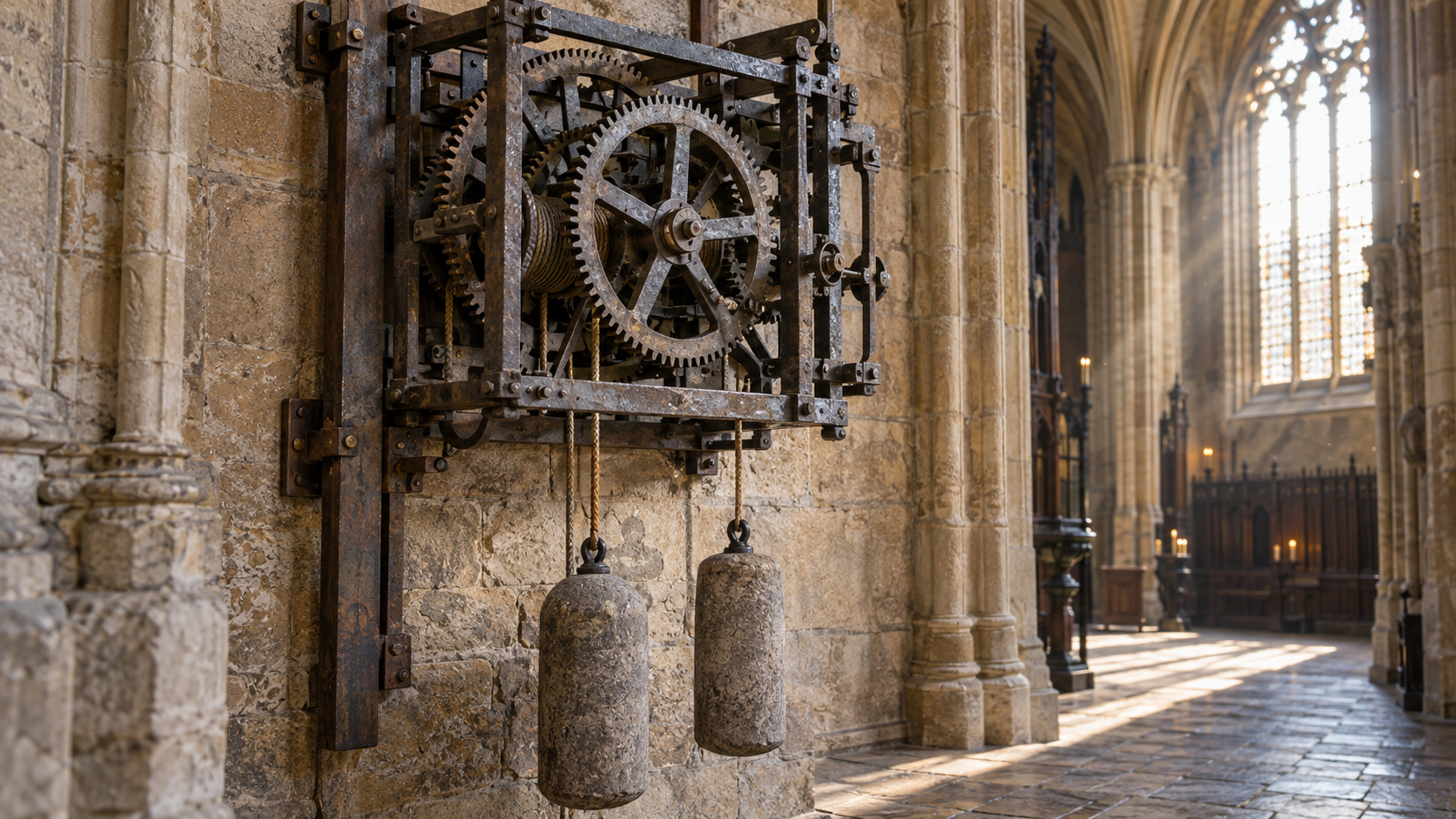
The clock in the north nave aisle of Salisbury Cathedral was made in 1386 or slightly earlier and has never stopped. It has no dial, because it was built to ring a bell on the hour, not to be read. Two stone weights drive it and someone winds it every day; the cathedral puts the running total at more than five billion ticks. After a new clock took over in 1884, this one sat forgotten in a tower until 1929 and was restored in 1956. Beauvais, Chioggia and Comayagua all put forward rival clocks. Source: Salisbury Cathedral.
A bank chartered in 1472
On 4 March 1472 the magistrates of the Republic of Siena approved the statute of a mount of piety that lent to the poor at 7.5 per cent. The institution descended from it is still trading as Banca Monte dei Paschi di Siena, usually described as the oldest bank in the world in continuous operation. The name comes from the Maremma pastures, the Paschi, whose income was pledged to back depositors when the bank was reorganised in 1624. Source: Gruppo MPS; Wikipedia.
A railway company that never got merged away (1832)
The Festiniog Railway Company was created by act of Parliament on 23 May 1832 to carry slate from Blaenau Ffestiniog down to ships at Porthmadog. When Britain's railways were consolidated in 1921 and again in 1948, this one stayed out, partly because it had already closed for traffic, which is why it still exists as an independent company. Loaded wagons once ran downhill by gravity and horses hauled the empties back up; steam came in 1863. Its Boston Lodge works still builds locomotives, the most recent in 2010, and the 1879 double Fairlie Merddin Emrys is in regular service. Guinness lists it as the oldest operational railway company; as a stretch of track, the Middleton Railway in Leeds is older. Source: Ffestiniog Railway; Wikipedia.
A paddle steamer with its original engine (1861)
Hjejlen was launched in Copenhagen in 1861 at a cost of 10,000 rigsdaler, about twice what the share subscription had raised, and for more than 160 years it has carried passengers on the lakes around Silkeborg in Denmark. It is the oldest coal-fired paddle steamer still running on its original engine, a two-cylinder machine of around 40 horsepower that manages about 8 knots. Passengers can watch the stoker shovel coal and the engineer oil the engine, because that is how it is still run. Denmark's Ship Preservation Foundation has listed it as a historic monument. Source: Hjejleselskabet; Wikipedia.
The list could be longer, and most entries have someone arguing the other side. That is partly what makes them worth listing: anything that has kept working for centuries leaves documents behind, and documents are what people argue over.



Ready to start your HMI project?
Our engineers help you choose the right HMI hardware and software for your project.