

NVIDIA's GTC Taipei put physical AI on the front page this week. The EU AI Act moved from paper to enforcement. Chinese cities rolled out industrial AI roadmaps. And a fleet of autonomous tractors started working real farmland without anyone in the cab. Different stories, same direction: AI is leaving the demo room.
NVIDIA ships an open physical AI stack at GTC Taipei
NVIDIA used its GTC Taipei keynote on August 31, 2026 to push a full physical AI platform. Cosmos 3, an open multi-modal model, handles text, image, video, environment audio and robot action in one system. The Isaac GR00T Reference Humanoid pairs a Unitree H2 Plus body with Sharpa dexterous hands, Jetson Thor compute and the Isaac GR00T software stack — research groups at AI2, ETH Zurich, Stanford Robotics Center and UC San Diego have signed on. Jensen Huang said this is the moment "the explosion of physical AI" goes mainstream. Cosmos 3 ships in two versions: Cosmos 3 Super for high-precision robotics and autonomous driving, Cosmos 3 Nano for faster edge inference (163.com, Aug 31, 2026).
On the safety side, NVIDIA Halos for Robotics — a full-stack system that ties AI compute to functional safety — was announced the same week, alongside a deeper partnership with TSMC. NVIDIA's CUDA-X libraries and AI models will now run through lithography, transistor simulation, process control, wafer inspection and fab scheduling. TSMC says its nanoscale defect detection is already improving on the NVIDIA Metropolis and TAO toolkits (NVIDIA newsroom, Aug 26, 2026).
What it means for HMI buyers: When one vendor ships the model, the reference robot, the edge AI computer and the safety stack, your integration cost drops. AOYU TECH panels paired with Jetson Thor or Orin Nano now sit behind a more uniform SDK and a clearer path to functional-safety certification.
EU AI Act's second wave is now in enforcement
The EU AI Act's second wave went live on August 2, 2026, and the August push is when it started to bite. The European AI Office can now investigate, evaluate and fine. Prohibited practices — manipulation of behavior, exploitation of vulnerable groups, social scoring, untargeted facial-recognition scraping — are fully enforceable. General-purpose AI (GPAI) providers must meet downstream disclosure, copyright and systemic-risk rules. Chatbots have to label themselves. AI-generated text, images, audio and video must carry machine-readable markers. Deepfakes must state they are synthetic (China MOFCOM summary, Aug 2026; EU AI Act Implementation Timeline).
The fines are not symbolic. Up to €35 million or 7% of global revenue for prohibited practices; up to €15 million or 3% for GPAI violations. Enforcement is split across the EU AI Office for foundation models and very large platforms, national competent authorities for everything else, and the European Data Protection Supervisor for EU institutions.
What it means for HMI buyers: Any panel that ships to Europe with on-device generative capability — a chatbot, a vision model, a code assistant — now needs an audit trail. Documentation, logging, copyright policy and a clear "this is AI" label are table stakes, not nice-to-haves.
Chinese cities start writing industrial AI into the city plan
On August 29, 2026, Jinan's Industry and Information Technology Bureau published the "AI + Manufacturing" Action Plan for 2026 to 2028. Goal: 40 or more industrial large models and intelligent agents deployed across manufacturing R&D, production, pilot testing and management by 2028. The plan sits inside a wider "1028" modern industrial framework — ten clusters, twenty-eight priority chains — and a "6+X" future industries list that puts AI, embodied intelligence and synthetic biology at the top (Jinan policy report, Aug 29, 2026).
The same week in Guangxi, Liuzhou Steel's hot rolling mill moved inspection out of the heat and into a centralized control room where operators watch parameters on screen. Yuchai's smart workshop has robots doing tightening and gluing. More than 5,000 industrial enterprises above designation size in Guangxi have started "smart transformation" projects. Tianjin Beichen has 60 smart factories up and running. On August 25, Nanjing passed a regulation that requires at least 70% of enterprise training funds to reach frontline workers (Smart Manufacturing Daily, Aug 30, 2026).
What it means for HMI buyers: Chinese municipal policy is now the demand driver. If you sell into a tier-2 city industrial cluster, the customer has a written three-year AI roadmap, and your HMI needs to support operator-facing AI agents, predictive maintenance and a fault-tolerant view layer on top of legacy PLC stacks.
Autonomous tractors go commercial in the sugar fields
On August 21, 2026, U.S. Sugar, Autonomous Solutions Inc. (ASI) and Everglades Equipment Group launched what they describe as the largest commercial deployment of autonomous tractors in the United States. The fleet is working 255,000 acres of sugarcane fields 24/7, including manned tractors retrofitted with ASI's autonomy kits running on the Robotti platform, Polaris utility vehicles and a custom path planner for sugarcane rows (Automation.com, Aug 21, 2026).
The move shifts autonomous agriculture from pilot to payroll. Ag machines don't need to deal with pedestrians and traffic lights the way robotaxis do, but they still need centimeter-grade row alignment, weather tolerance and 24-hour uptime. Those are the same conditions any outdoor industrial robot faces at a port, mine or solar farm.
What it means for HMI buyers: Cab displays and remote HMI panels for off-road equipment are starting to look like fleet dashboards. Map view, telemetry summary, fault inbox and OTA update status are taking the place of analog gauges. The same fleet-management software that runs tractors can run unmanned forklifts or mining trucks — and the HMI is the front end.
Six months ago, physical AI was a slide in a keynote. This week it was an open model, a reference robot, a deployed policy and a commercial fleet on a real farm. The pace is the surprise, not the direction. For HMI buyers and panel integrators, the takeaway is simple: the "AI layer" is moving from cloud server to factory floor, and the panel between the operator and the machine is where it shows up first.
Need a panel, an Android-based touch controller or a custom open-frame HMI that can host on-device AI agents and survive a 24/7 industrial shift? Tell us your application — voltage, mounting, environment, certification targets — and our engineers will sketch a spec inside 48 hours. Submit your inquiry via the inquiry form.
Related products
Explore our HMI panels
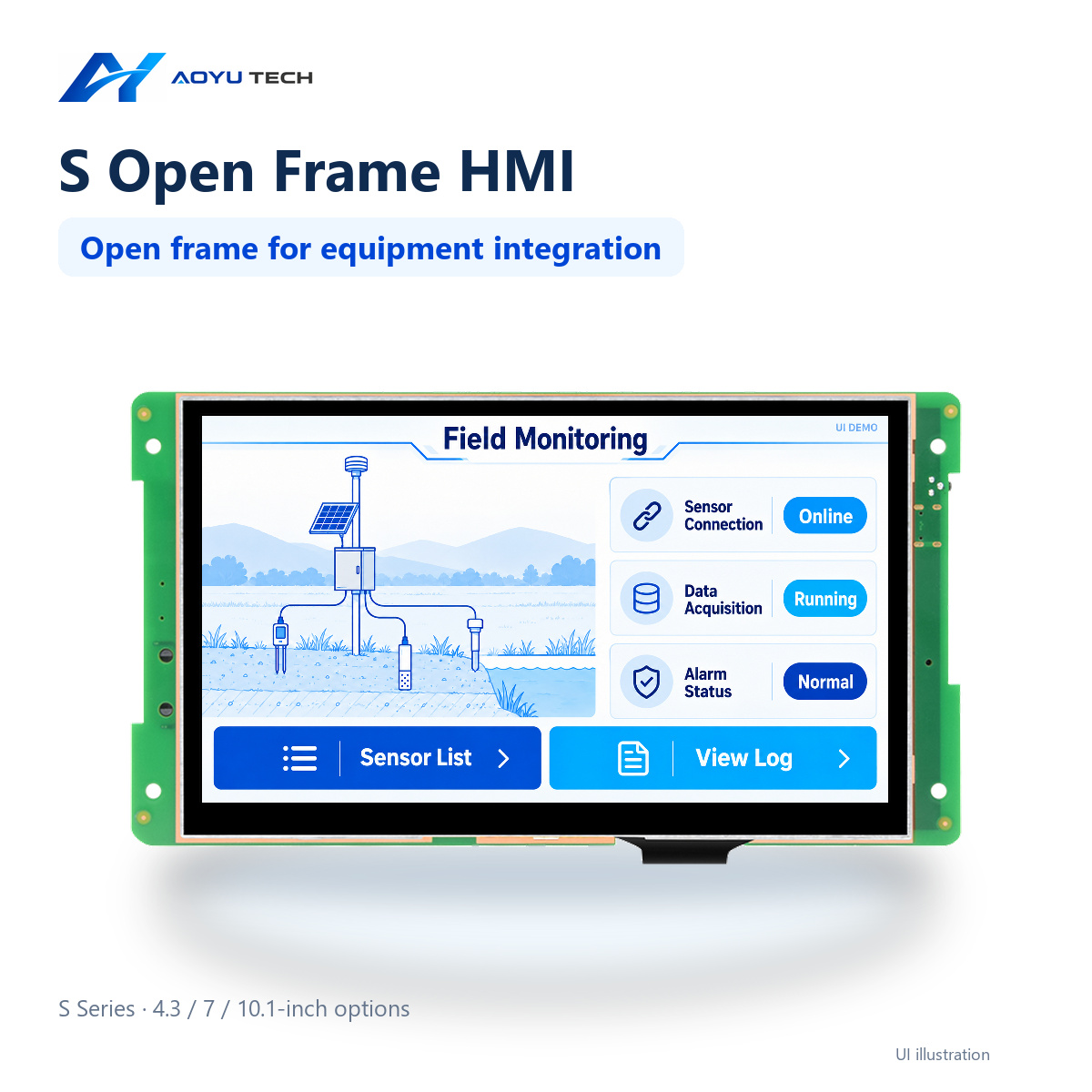
S-043 4.3-inch HMI Panel
Size: 4.3 inches. Resolution: 800 × 480 px. Backlight brightness: 500 cd/m². Viewing angle…
View product →S-070 7-inch HMI Panel
Size: 7 inches. Resolution: 1024 × 600 px. Backlight brightness: 500 cd/m². Viewing angle:…
View product →S-101 10.1-inch HMI Panel
Size: 10.1 inches. Resolution: 1024 × 600 px. Backlight brightness: 500 cd/m². Viewing ang…
View product →Ready to start your HMI project?
Our engineers help you choose the right HMI hardware and software for your project.